
Engineering starts with the right questions.
Jalaranu explores the underlake datacenter as one complete system. Module placement needs to be evaluated together with power, networking, heat management, maintenance, and recovery.
From shore interfaces to the underwater environment.
The project architecture includes four elements: shore-based support facilities, power and communications connections, the computing module, and monitoring and operational management. Their relationships determine how the overall facility can function and recover.
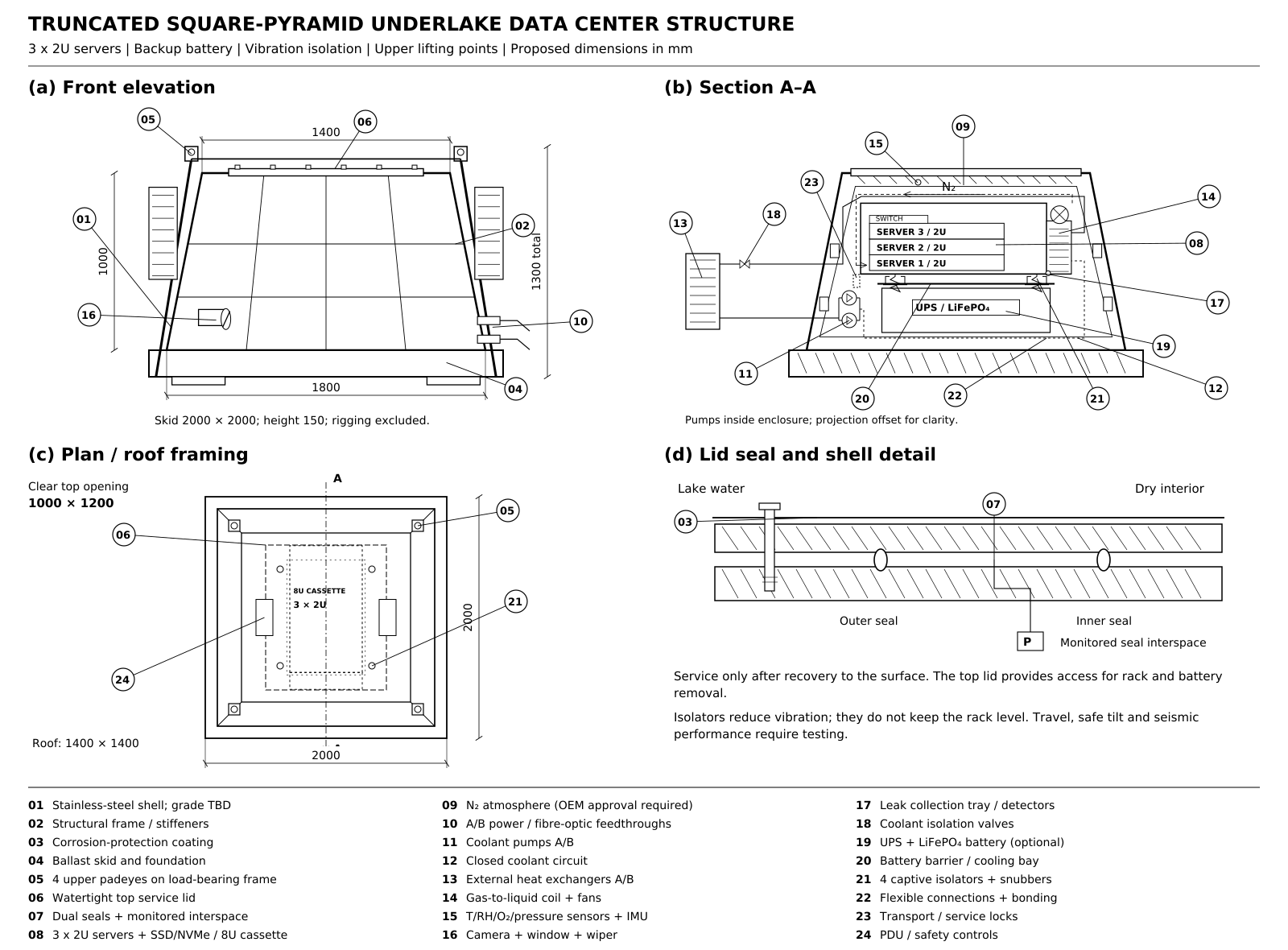
Early visualisations use a truncated square pyramid. This is a design exploration; final geometry, materials, and specifications will follow engineering and test findings.
A block diagram and cross-section showing logical connections, without coordinates or facility-security details.
Inside Jalaranu
The reference structure breaks the module into 24 numbered components across six systems. The figure is a dimensional engineering draft, not a fabrication drawing.
Protective enclosure
Stainless-steel shell, structural stiffeners, and corrosion protection, carried by a ballast skid. Lifting loads pass through four upper padeyes, while the service lid keeps two seals separated by a monitored interspace.
Computing cassette
An 8U cassette holds three 2U servers with SSD/NVMe storage and a network switch, under a proposed nitrogen atmosphere with controlled humidity and A/B power and fibre feedthroughs.
Cooling loop
A gas-to-liquid coil and fans move heat into a closed coolant circuit through A/B pumps and A/B external heat exchangers. Isolation valves separate branches, and lake water never mixes with internal coolant.
Power resilience
An optional LiFePO4 battery UPS sits in a lower bay separated from the computing equipment, targeting a ten-minute reserve at the assumed 2.1 kW load.
Vibration isolation
Four captive isolators with cushioned snubbers suspend the server cassette, with flexible connections, electrical bonding, and transport and service locks.
Monitoring and safety
Temperature, humidity, oxygen, pressure, and motion sensors, a camera with window and wiper, and a leak-detection tray feed power distribution and safety controls.
All stated values are design assumptions, not measurements. Watertightness, operating depth, lifting capacity, and seismic resistance remain to be established through analysis and integrated testing.
Five areas to evaluate.
Heat management
Water conditions, heat transfer, computing loads, and the energy required by supporting systems.
Module integrity
The ability of structures, joints, and system interfaces to withstand the defined operating conditions.
Power and connectivity
Service needs, redundancy options, behaviour during connection failures, and recovery procedures.
Maintenance
What can be monitored remotely, when intervention is required, and how the module can be handled or retrieved.
Security and control
Administrative access, event monitoring, key management, operator responsibilities, and protection of physical and digital interfaces.
Advantages need to be assessed against relevant alternatives.
Evaluation should compare the underlake project with land-based solutions using equivalent service requirements, workloads, and assumptions. Relevant comparisons include land-based facilities with conventional cooling and water-based cooling, where applicable to the site under study.
Assessment covers energy, capital expenditure, operating costs, maintenance, connectivity, recovery, environmental effects, and end of life. Potential savings in one component do not in themselves demonstrate a lower total cost.
Placement alternatives, compared honestly.
The underlake project is evaluated against three reference placements at equal service: a terrestrial facility, a hardened bunker, and an undersea deployment. Each trade-off below is an initial assessment to be tested, not a measured result.
A companion ten-year cost model at equal service gives 6.00 million dollars for a terrestrial facility with conventional cooling, 6.34 for a hardened terrestrial facility with lake-water cooling, and 7.85 for the submerged design. Submersion buys capability, not cost saving.
| Criterion | Underlake datacenterFreshwater lake | Undersea datacenterOcean deployment | Terrestrial datacenterConventional cooling | Hardened bunkerReinforced shell |
|---|---|---|---|---|
| Operational maturity | Prototype and testing in progress | Proven at sea (Project Natick) | Proven operations | Proven for critical workloads |
| Physical protection | Pressure hull, inland water column | Hardened shell, remote siting | Site security, exposed perimeter | Reinforced construction, restricted access |
| Heat rejection | Passive water cooling, thermal budget unmeasured | Passive water cooling | Mechanical cooling, energy cost | Complex confined heat rejection |
| Jurisdiction | Domestic inland waters | Contested maritime zones | Domestic, urban corridors | Domestic |
| Land threat surface | Submerged module, shore station remains exposed | Remote at sea, shore station remains exposed | Direct perimeter access, site security required | Reinforced against intrusion, restricted access |
| Air threat surface | Module shielded by the water column, shore station exposed | Exposed surface support at sea | Fully exposed from the air | Hardened against aerial threats |
| Maritime threat surface | Out of submarine reach | Submarine cable interception, anchor drag | None | None |
| Scalability | Lake-limited modules | Site-limited modules | Hyperscale clusters | Harder to scale |
| Ten-year cost model | $7.85M | Not modeled | $6.00M | $6.34M |
| Evidence status | Computed | Proven pilot | Measured | Measured |
Initial framework assessment for discussion. Figures and rankings require measurement and site studies. Screening thermal numbers (a basin-average anomaly of about 0.001 kelvin over fifty years and a twelve-month footprint of 228-509 metres) carry unproven status until measured.
Use cases under exploration
The project can be evaluated for dedicated computing, storage, or particular infrastructure requirements defined by an organisation. The suitability of each use case must be established through requirements assessment and test evidence.
A use case mentioned here is not a statement that the service is already available or approved to handle sensitive data.